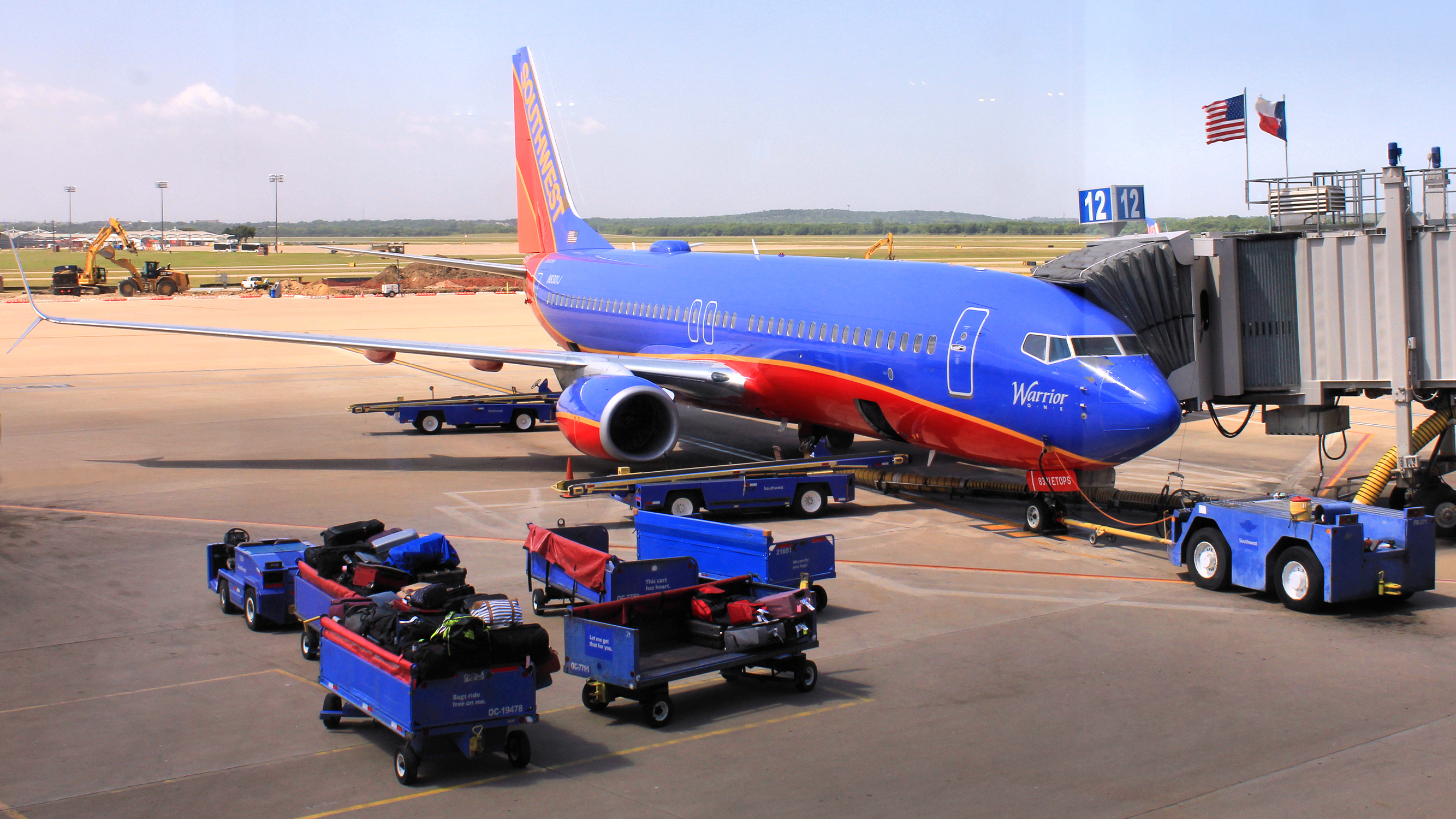
Texas departures and eligible U.S. trips
Southwest has expanded Sip and Ship to four Texas departure airports. Travelers aged 21 or older can check one qualifying wine case free on eligible U.S. trips, with domestic connections allowed. The wine case does not count against the normal checked-bag allowance.
The airline announced the Texas addition on November 9, 2026, describing the expansion as having happened the previous week. It celebrated the debut that past weekend at the Austin Food & Wine Festival. Southwest says the program had launched earlier in the year at 19 select West Coast airports; the Texas announcement extends that existing wine-case benefit.
The Texas airports are Austin-Bergstrom International Airport (AUS), Dallas Love Field (DAL), William P. Hobby Airport in Houston (HOU), and San Antonio International Airport (SAT). Check the departure airport itself: the program’s current terms identify these four airport codes, so an itinerary involving another airport in the same state does not automatically qualify.
The benefit applies to selected Southwest flights originating at participating airports and traveling within the United States. Connections are permitted as long as the trip stays within the U.S. Flights departing nonparticipating cities do not qualify and standard checked-bag fees apply. Flying to an eligible destination does not by itself make the trip eligible.
A separate wine-case allowance and its limits
No Rapid Rewards membership is required. Southwest’s program page illustrates the benefit as saving $45 in checked-bag fees per passenger, based on its checked-baggage fees. The important allowance rule is that a compliant wine case stays outside the normal checked-bag count, even when other bags are checked. Other baggage and optional packaging costs remain separate from this wine-case waiver.
One case means a single box or specialized wine suitcase containing no more than 12 bottles. It must weigh no more than 50 pounds (22.7 kilograms) and measure no more than 62 inches in total length, width and height. Include wheels and handles in the measurement. These are the limits for the free case.
Pack the bottles and arrange the airport inspection
Keep the wine in its original unopened containers with the manufacturer’s labels. The bottles must go inside a sealed, leak-proof plastic bag with professional packaging fitted to their proportions to prevent breakage. The outer container must be sturdy and leak-proof, such as a corrugated box or specialized wine suitcase, with enough strength for airline baggage handling.
The program page requires additional leak-proof protection around the glass. It lists Styrofoam, molded foam inserts, cardboard liners, bubble wrap and extra padding as packing options; the Help Center strongly recommends that protection. Professional packaging from a wine supplier is acceptable when it provides adequate cushioning and prevents leakage. Protecting the bottles and leaving the outer box open are separate requirements.
Leave the top of the primary shipping container unsealed before arriving at the airport. Bring it to a Southwest Customer Service Agent at the ticket counter or Help Desk for inspection. After approving the packing, the agent will seal and label the case and check it without a bag charge. The sealed inner plastic bag does not replace this inspection, and all alcohol remains subject to TSA screening.
If more protection is needed, Southwest says a padded wine bag can be purchased at the counter for $5 per bottle. That is a packaging charge, separate from the free checked-case benefit. The Help Center also confirms that wine packaging is available for sale when a case is not adequately packed.
At the final destination, look for the case at baggage claim. Southwest advises checking the oversize baggage area if it is not there, because many airports keep fragile items separate.
When additional baggage charges apply
Only one wine case is free. Additional cases are subject to the applicable checked-bag charges in Southwest’s [Optional Travel Charges](https://www.southwest.com/html/customer-service/travel-fees.html) schedule. For U.S. Mainland travel, the published third-and-additional checked-bag charge is $150. It is therefore important to distinguish the single exempt wine case from extra baggage being checked under the regular rules.
The program FAQ directs overweight or oversized cases to the baggage-fee schedule. For U.S. Mainland travel, an item weighing 51–70 pounds incurs $100 in addition to the standard bag fee; 71–100 pounds incurs $200 plus the standard fee. An item larger than 62 inches but no larger than 80 inches incurs $200 plus the standard fee. These are charges outside the free-case limits, not a larger free allowance.
If a piece is both oversized and overweight, Southwest applies one $200 size-and-weight charge on top of the standard baggage fee, provided it does not exceed 100 pounds. Excess baggage that is also oversized or overweight attracts the excess-bag charge plus the applicable size or weight charge. The general limit is 20 checked pieces per customer per flight, including free-allowance pieces. Southwest reserves the right to change its published prices.
Other participating origins and the empty-case example
The current program also lists California departures from Burbank, Fresno, Long Beach, Los Angeles, Oakland, Ontario, Orange County/Santa Ana, Palm Springs, Sacramento, San Diego, San Francisco, San Jose, Santa Barbara and Sonoma County. Other participating origins are Boise in Idaho; Eugene and Portland in Oregon; and Seattle/Tacoma and Spokane in Washington. These are existing program locations; the fresh announcement concerns the four Texas additions. The eligibility-code lists are California: BUR, FAT, LAX, OAK, ONT, SNA, PSP, SMF, SAN, SFO, SJC, SBA, STS and LGB; Idaho: BOI; Oregon: EUG and PDX; Washington: SEA and GEG.
For travelers planning a wine-country trip, the Help Center addresses an empty wine suitcase or box on the outbound journey. Its answer says normal bag fees apply when wine or packaging materials are checked somewhere outside the participating airports. Do not assume an outbound trip from a nonparticipating city gets the waiver merely because the return trip will begin at an eligible Texas airport.
State rules, breakage and programme updates
State wine-quantity rules can impose their own limits. Southwest tells travelers to check the rules of the relevant state, so the carrier’s 12-bottle maximum should not be treated as a promise that every state permits that quantity. Review those requirements while planning the case, as well as the airline’s origin and packing conditions.
Southwest does not accept liability for breakage of liquids or fragile items in checked luggage, including when the passenger buys special packaging from the airline. Paying for a padded bag therefore does not remove that stated limitation.
Use the current [Sip and Ship program page](https://www.southwest.com/sip-and-ship/) and its [Help Center policy](https://support.southwest.com/helpcenter/article/sip-and-ship) before traveling. Southwest can amend, suspend or change the program and its terms without notice. The saved announcement and policies do not give a booking deadline or a promised end date for the Texas benefit.